“Hello, my name is Danny, and I am a clown.” That’s how our clowning class
began. Every camper walked across the space in total neutrality and sat
in the chair, looked at everyone, said that one line, and walked off
stage. Dan Kennedy, a long time ASC actor and experienced clown, started
the class by saying that “the hardest thing you’ll ever be asked to do
onstage is nothing.” The campers began by attempting to show nothing,
and even though everyone was trying hard to remain neutral, their
personalities showed through anyways -- personalities that we would
exaggerate and expand as the class went on.
To
shake things up, next we did a bunch of fast theater games -- keeping a
ball in the air, bippity-bippity-bop, woosh-woah-zap, and then a game
of silent redlight-greenlight. As they played, the campers and Dan
together looked at the comedy in the games. When the redlight greenlight
game started to lose energy, he shook it up and turned it into “oscar
variety” red-light green light and set up a scenario of a flock of girls
running to meet a particularly handsome man, but not wanting him to
know of their attempts to get close to him. The running and stopping of
red-light greenlight became a game of posing, of sudden changes of
attitude. One girl would be running for all she was worth one second and
the next second she would have frozen - effortlessly arranging her hair
when the guy was turned to see her. Dan threw in lots of obstacles for
the kids. One time when they guys were the ones racing, they needed to
“look sexy” when the lady turned their way, but since they had been
running the moment before they were not necessarily in a good position
to make that work, they had to find a way to “deal with the problem”
they’d created for themselves. These campers had to make strong choices.
Specific choices. Big choices. Clowns are made of big choices. And so
we zipped to the next exercise.
FUNNY
WALKS. This clown routine is one all about imitation and exaggeration.
The campers paired up and then followed their partners around, imitating
any quirks or personality exaggerating the idiosyncrasies to the point
of absurdity. Then all the funny walks paraded around, and though they
were crazy, the walkers strode with absolute seriousness. We learned
about poker faces and how serious presentations can be much funnier than
goofy acts. Then we traveled on to playing with props.
The
campers divided into groups, and Dan gave each group a bunch of props
with the instruction to use the prop to tell as many different stories
as possible, without using any words. So suddenly a pasta strainer
became a hat and a magnifying glass and butterfly net and land mine and
dozen other things. Flip flops became a defibrillator, then the flip
flops became the ears of a baby elephant (with a pool noodle trunk and a
laundry basket body); the laundry basket became a boat and the boat
became an umbrella, and an umbrella became the head of a rattlesnake
made of all the campers in the group with a tambourine for its rattle at
the tail. Creativity poured right out of these kids, and it led us
right into our last exercise.
Dan
divided them into groups of three, and those groups each had to make up
a scene, without any words, with this scenario: A couple is at a
restaurant. A waiter is annoying. A proposal occurs. What makes it a
clown scene? How high the stakes are can make it a clown scene. Are the
couple a little bit in love? Or madly, wildly, passionately in love? Is
the waiter a little annoying or annoying beyond comprehension and
belief? Is it McDonalds or a five star cuisine with 7 courses? They made
the scenes in 4 minutes flat, and every one had us in stitches.
Comedy. It’s serious business.
Header Picture

Showing posts with label workshops. Show all posts
Showing posts with label workshops. Show all posts
30 July 2012

27 July 2012
Elizabethan Dance with Jeremy West
 What
do a a group of 18 teenagers do on a Wednesday morning at this camp?
They gather in a great open space, walled by huge windows which pour in
the sunlight, and they learn four hundred year old dance moves. Jeremy
West, a favorite teacher in this camp, and this session’s director of Henry VI, Part One,
usually teaches stage combat, but session he teaches these campers
dancing as well. The two disciplines have a great deal in common. Both
consist of choreographed movement on stage following a series of set
moves, and both require careful teamwork, but there the similarities
end.
What
do a a group of 18 teenagers do on a Wednesday morning at this camp?
They gather in a great open space, walled by huge windows which pour in
the sunlight, and they learn four hundred year old dance moves. Jeremy
West, a favorite teacher in this camp, and this session’s director of Henry VI, Part One,
usually teaches stage combat, but session he teaches these campers
dancing as well. The two disciplines have a great deal in common. Both
consist of choreographed movement on stage following a series of set
moves, and both require careful teamwork, but there the similarities
end.  Jeremy
told the campers that he’d be teaching them a jig, and he asked if
anyone knew anything about jigs. In Shakespeare we know of jigs as court
dances, but also as the dance that actors would perform at the end of
plays. Today they have rather different cultural place. Most of the
campers mentioned them as “pub dances” or “sort of Irish-y.” Elise, one
camper who Irish dances competitively, shared the names and types of all
the jigs in contemporary Irish Dance, and (when we begged her) she
demonstrated these dances as well.
Jeremy
told the campers that he’d be teaching them a jig, and he asked if
anyone knew anything about jigs. In Shakespeare we know of jigs as court
dances, but also as the dance that actors would perform at the end of
plays. Today they have rather different cultural place. Most of the
campers mentioned them as “pub dances” or “sort of Irish-y.” Elise, one
camper who Irish dances competitively, shared the names and types of all
the jigs in contemporary Irish Dance, and (when we begged her) she
demonstrated these dances as well. Which brought us to learning our own Elizabethan dance from Jeremy. Listening to a Renaissance consort’s formal but upbeat music, we watched and learned from Jeremy’s easy grace and confidence. In this dance, and in many Elizabethan dances, the moves are not difficult; most of them are simply ordered steps, claps or holding one’s hands in a particular shape. But it’s not about the difficulty of a particular move -- It’s about style. As Jeremy says, “It’s about having the chutzpah to say, ‘I look awesome when I do this move.’” So the campers practiced their moves. Some campers have extensive backgrounds in dance, and at first it was easy to pick out the trained dancers. They were the ones who held their backs straight and upright. They looked directly at their partners. They were specific in the details of each move, pointing their toes or aware of the shape of their hands. But as the workshop went on and everyone practiced more and switched partners again and again, the less experienced dancers learned from the more experienced ones. At one point Justin (a camper regularly teaching other campers to swing dance) danced with Liam, a camper with a casual careless physicality. As they danced, Justin took on some of Liam’s swagger and Liam became much more precise and clear in his movements, and they were both loving every bit of it. Everywhere you looked you could see campers helping each other, and by the end, the whole group moved in striking unison, and I couldn’t remember who had looked like experienced dancers and who didn’t. It was such a pleasure to watch.

24 July 2012
Dab, Slash, Flick: Laban Movement with Patrick Earl


Patrick explained that while Laban obviously aids the actor with his or her physical choices when forming a character, it can also be applied to vocal choices as well. To illustrate this, Patrick asked the campers chose between two short monologues, one being Romeo’s proclamation that banishment is worse than death, and the other Juliet’s plea to her mother to break her engagement to Paris. The campers walked around the room and read their monologues eight times, each time reading in the style of one of the eight different effort actions. This way they could see which parts of the monologue fit well with certain actions. The campers then chose four to five of the actions and incorporated these actions vocally into their text. For example, Romeo may start out with a slash, then move into a punch, a dab, a wring, and end with a glide.

--Emma Lo
19 July 2012
Box-kicking with Bob Jones
Bob Jones, known around ASC Theatre Camp as a favorite lecturer for his wealth of wisdom, discussed the differences between voice and prose at his lecture on Wednesday.
 Verse is a form of writing with a metrical rhythm and strict rules (which many writers, including Shakespeare, do not always follow precisely). Because of its beat-like flow, verse is generally much easier for the actor to memorize and also for the audience to remember. In Shakespeare’s day at a live, crowded theater like the Blackfriars Playhouse, some audience members would have trouble hearing all of what the actors were saying. The structure of verse emphasizes the most important words as stressed syllables, so even if only the stressed syllables are heard, the audience member would have a good grasp of what the actor was trying to communicate. For example, Hamlet’s “To be or not to be” line without the unstressed syllables would read “be not be is quest”. Bob pointed out that those words alone are the meat of Hamlet’s entire speech, and essentially of the entire play.
To help the campers understand verse more fully, Bob got them on their feet for a physical exercise. First, he assigned every camper a line from a scene between Claudio and Don Pedro from Much Ado about Nothing. Bob instructed them to use scansion to determine which syllables were stressed and unstressed. “Now gallop your line!” Bob announced. Each camper tapped out the line according to the stressed and unstressed syllables. The campers with more irregular lines tripped a little on the way, but Bob helped everyone produce an accurate gallop by the end. Here are several examples Bob provided of regularities and irregularities in Shakespeare’s verse:
CLAUDIO
˅ / ˅ / ˅ / ˅ / ˅ /
Give not this rotten orange to your friend
This is an example of a regular verse line. It has ten syllables that alternate stressed and unstressed and it begins on an unstressed syllable.
HAMLET
˅ / ˅ / ˅ / ˅ / ˅ / ˅
To be or not to be that is the question
You’ll notice that this line has an extra, unstressed syllable at its end, which is referred to as a “feminine ending”.
BEDFORD
/ / ˅ / ˅ ˅ / / / ˅ /
Hung be the heavens with black, yield day to night!
Here Shakespeare breaks all the rules of verse, using several “spondees,” or feet where both of the syllables are stressed. This irregularity in verse would catch the audience’s attention. In this case, the excess of stressed syllables make the line sound more powerful and reinforce the line’s meaning – but, you can see how this line would be difficult to gallop.
 In contrast to verse, prose sounds much like how people converse today and has no complex stressed and unstressed structure. A King and No King, one of the three plays in Session 2, is written mostly in prose . While looking at an excerpt of text from this play, the campers noted that there are more punctuation marks, caesuras, and meter shifts than there typically are in Shakespeare’s text. Francis Beaumont and John Fletcher wrote A King and No King during a period when the vogue in writing was moving from verse towards prose, and this play contributed to that transition. Here is an excerpt that when read aloud, sounds like every day speech. Bob noted that Shakespeare never ended a sentence after two syllables into a line, as Beaumont and Fletcher have done here with “So long.”
ARBACES
Bessus, go you along too with her. –I will prove
All this that I have said, if I may live
So long. But I am desperately sick,
 After his overview of verse and prose, Bob covered the importance of the last word in a line. While the stressed syllables are more important that the unstressed, the last word in a line is the most important out of all of them. Bob brought out three mysterious white boxes and instructed the campers to choose a small section of their own lines to work on. Then he told them to recite their chosen text by walking during the line and turning abruptly on the last word before beginning the next line. When the campers had perfected their sharp turns, Bob added in the boxes. Now the campers gave the boxes a swift kick on the last word, an even more forceful movement than the turn. This exercise made the campers extremely conscious of putting emphasis on the final word. Bob explained that physicalizing this emphasis helps you to get vocal ideas, and can help you to give phrases weight. At the end of the lecture, Bob opened the white boxes to reveal that a Complete Works of Shakespeare had been hiding in each! The campers laughingly bemoaned the fact that they’d been abusing their idol for the last hour.
The campers left Bob’s lecture with more comprehensive understanding of how Shakespeare, Beaumont, and Fletcher use verse and prose and of their purposeful switches between both throughout the plays. One of the most difficult challenges in performing Shakespeare and his contemporaries is deciphering the playwright’s intent that is hidden within the structure and then actually executing the iambic pentameter. Thanks to Bob, the campers are now prepared to attack their plays, galloping and kicking their way through tongue-tripping text.

To help the campers understand verse more fully, Bob got them on their feet for a physical exercise. First, he assigned every camper a line from a scene between Claudio and Don Pedro from Much Ado about Nothing. Bob instructed them to use scansion to determine which syllables were stressed and unstressed. “Now gallop your line!” Bob announced. Each camper tapped out the line according to the stressed and unstressed syllables. The campers with more irregular lines tripped a little on the way, but Bob helped everyone produce an accurate gallop by the end. Here are several examples Bob provided of regularities and irregularities in Shakespeare’s verse:
CLAUDIO
˅ / ˅ / ˅ / ˅ / ˅ /
Give not this rotten orange to your friend
This is an example of a regular verse line. It has ten syllables that alternate stressed and unstressed and it begins on an unstressed syllable.
HAMLET
˅ / ˅ / ˅ / ˅ / ˅ / ˅
To be or not to be that is the question
You’ll notice that this line has an extra, unstressed syllable at its end, which is referred to as a “feminine ending”.
BEDFORD
/ / ˅ / ˅ ˅ / / / ˅ /
Hung be the heavens with black, yield day to night!
Here Shakespeare breaks all the rules of verse, using several “spondees,” or feet where both of the syllables are stressed. This irregularity in verse would catch the audience’s attention. In this case, the excess of stressed syllables make the line sound more powerful and reinforce the line’s meaning – but, you can see how this line would be difficult to gallop.

ARBACES
Bessus, go you along too with her. –I will prove
All this that I have said, if I may live
So long. But I am desperately sick,

The campers left Bob’s lecture with more comprehensive understanding of how Shakespeare, Beaumont, and Fletcher use verse and prose and of their purposeful switches between both throughout the plays. One of the most difficult challenges in performing Shakespeare and his contemporaries is deciphering the playwright’s intent that is hidden within the structure and then actually executing the iambic pentameter. Thanks to Bob, the campers are now prepared to attack their plays, galloping and kicking their way through tongue-tripping text.
--Emma Lo
18 July 2012
Music as Human Nature: Workshop with Greg Phelps
Greg Phelps began his Music Workshop with a nearly unanswerable question, “Why is there music?” But after pondering for a minute or two, the ASC Theatre Campers were full of answers for him. Campers began to list purposes for music, suggesting that music is way to express emotions and a way for humans to master the sounds they hear.
 The conversation took on a free form, and Greg introduced other questions , such as “What is silence?” which had the campers debating the existence of silence altogether. Session 2 differs from Session 1 in many ways, and the difference in assertiveness and leadership was evident today. These older campers turned the “masterclass” into more of a seminar, where the class began to drive the conversation with their inquiries and inventive ideas. One camper mused that we as humans are both master and servant to noises, in that we have a natural inclination to control and organize these sounds, but also must use them for creation. Another pointed out that not only is music a way to express personal emotions, but it is a way to inspire emotion in others. An example a camper came up with is that in a movie, the soundtrack serves as a cue to the audience for what mood a scene is in.
Greg reinforced all the ideas that the campers brought up, offering support with anecdotes and related information. The general conclusion was that music is tied to the human race’s ability and will to create. Greg explained that “we’re still animals, but we can create. Birds know how to mimic other sounds, but to take ‘part a’ and ‘part q’ and put them together, that’s solely human. Nothing else does that. It sets us apart.”
 The campers discovered that another singularly human aspect of music is its communal nature. Music brings people together so they can share a moment of collective emotion, sometimes simply just to have a good time. One camper pointed out that everyone has participated in a loud, rousing chorus of Journey’s “Don’t Stop Believing” at one point or another. And it doesn’t matter if you don’t know all the words or if you’re completely tone deaf: There is something about singing in a large group of people that ties to the human need to belong and be accepted by fellow humans.
 As the campers continued to explore these inventive theories for over an hour, Greg finally had to put a halt on Music Philosophy 101 so that the campers could unpack their instruments, warm up their voices, and start composing. Out of sea of black cases came a mandolin, many guitars, a bass, an Irish hand drum, two violins, and a trumpet. The campers received a variety of lyrics from different Shakespeare plays to choose from, and this group selected “O Mistress Mine” from Twelfth Night to set to music. The room divided between singers and instrumentalists. Greg acted as a communicator between the two groups so that their independent work would match up when put together. First, the musicians came up with a basic chord progression which the singers then built a melody around. After establishing the basic structure, the piece blossomed with the addition of harmonies, embellishments, and instrumental solos. The group was lucky to have counselor and music major, Zach Fichter, along with dramaturg and violinist Clara Giebel to assist with the composition. In the end, the campers’ rendition of “O Mistress Mine” sounded professional, thanks to the talent of this group and Greg’s wonderful guidance. ASC Theatre Camp will most likely use the song for their pre-show.
 Throughout the entire workshop, the campers had to actively say “yes” to the ideas of their peers in order to make this collaborative process happen. You’ll notice that this is a recurring theme that pops up in just about everything we do at this camp! The song would not have been nearly as complex or interesting without the positive reinforcement that the campers displayed. To emphasize the importance of positivity, Greg asked everyone to put their hands in middle and yell an enthusiastic “YES” to finish off the workshop. As the campers filed out of the room to head off to lunch, each was humming proudly the melody of their newly composed song.

Greg reinforced all the ideas that the campers brought up, offering support with anecdotes and related information. The general conclusion was that music is tied to the human race’s ability and will to create. Greg explained that “we’re still animals, but we can create. Birds know how to mimic other sounds, but to take ‘part a’ and ‘part q’ and put them together, that’s solely human. Nothing else does that. It sets us apart.”


--Emma Lo
11 July 2012
Midsummer Day Camp: Wednesday
After
lunch, the campers were treated to a fight choreography workshop with Jeremy, a
fight instructor who has previously acted on the Blackfriars stage, and
frequently as fight captain. Jeremy first explained that safety is fight
choreography’s number one priority. The key to safety is to maintain open
communication between the attacker and the victim, and to perform the
choreography at a slow speed until the actors commit the hits and moves to
muscle memory. Campers partnered up, and Jeremy taught how to check a safe
distance before commencing with fight moves.
Once separated into partners, the campers
learned Step One of pre-hit prep. Partner A (the attacker) was instructed to
reach out as far out in front as possible with his/her arm. Partner B (the
victim or defender) was instructed to put his/her thumb to his/her chest and,
forming the hand in the “hang loose” position, was to reach his/her pinky as
far out in front as possible. If Partner A’s hand could touch Partner B’s
pinky, then the partners were too close together and needed to move father
apart. Optimally, Partner A’s hand should almost,
but not quite, touch Partner B’s pinky. Step Two of pre-hit prep is eye
contact, which establishes that the attacker is ready to hit, and that the
victim is ready to be hit. After establishing safe distance and eye contact,
the campers were prepared to learn their first fight move.
Jeremy began by teaching a simple
proscenium slap. Partner A was to swipe at Partner B with the palm of his/her
hand (at the safe distance). Partner B was to respond as if he/she had been
hit, and produce the nap of the hit by clapping at the chest. The nap is made
by one of the actors at the instant of a choreographed hit to simulate the
sound of an actual hit. After learning the basics of the slap, the partners
practiced at Matrix slow-motion speed
for several minutes, and then were instructed to speed up when both partners
felt comfortable. Thereafter the haymaker punch—the same as the proscenium slap, only produced with a fist rather than an open hand—was taught, and the partners switched
roles to practice it. Several additional points about fight choreography were brought up after
the campers practiced the punch.
As Jeremy explained to the young actors,
the reaction to the hit is even more important than the hit itself. The
victim’s responsibility is to effectively communicate to the audience that
they’ve indeed been hurt, precisely how they’ve been hurt, and how badly they've been
hurt. The attacker aides the victim by producing a bigger prep—raising the fist
or hand higher and more dramatically—for a bigger hit. These rules, of course,
do not apply to real life. For instance, real fighting—such as fencing or martial
arts—relies on speed. Presentation, however, is the priority of fighting on the
stage. The actors are charged with telling a story, not fighting like real
fighters.
After going over these concepts with the
campers, Jeremy taught them an uppercut punch, which requires the
attacker, rather than the victim, to produce the nap. The campers practiced the
uppercut at the customary slow speed. When the group seemed comfortable with
all three hits—the proscenium slap, the haymaker punch, and the uppercut—Jeremy
gave them ten minutes to “choreograph” a fight scene using all three. Everyone
responded to this task with gusto. One pair even created a dramatic backstory
involving stolen cookies. The result was a (controlled) frenzy of hits and fake broken noses.
The workshop with Jeremy taught the
young actors that fight choreography, while exciting, is no joking matter.
Discipline, communication, trust, and focus are all required to ensure a safe
and effective fight onstage. The campers learned all of these elements to
better understand how fight choreography is treated in professional settings, such
as the Blackfriars Playhouse. Now, when they see a choreographed fight at the ASC, they will better appreciate the hard work that was required to make it effective.
-Lee Ann Hoover, Education and Dramaturgy Intern
09 July 2012
Session 1 Camper Interviews

Muslima Musawwir
Muslima is a first-time camper from Richmond, Virginia. Next year, she will be attending Shenandoah University.
What role do you play? Olivia in Twelfth Night
How are you similar to your character? Dissimilar?
We’re not similar in all of the people that she’s lost; she lost her father and brother, and she’s numb emotionally throughout the majority of the play. We are similar because in order for her to be so numb, she must have loved her family, and I have a lot of love for my family. Also she takes control of everything, and I’ll say this – I’m the leader! And she’s fascinated with the whole idea of love, the whole thought of love in general, and I am too.
How did you find out about ASC Theatre Camp/why did you choose to spend your summer here?
I came to see Much Ado about Nothing, and I got one of the flyers, and I was interested--I wanted to do it! Last summer I did training with Shakespeare also, but I didn’t get a lot out of it. So I wanted to get more training since I’m going to college this year.
How does ASC Theatre Camp compare to other productions you’ve been in?
For me, you get more out of ASC Theatre Camp because you actually get the workshops. It’s not just the plays, you get masterclasses and pre-show, and then you get to see actors doing professional shows. We’re learning from people who have been doing Shakespeare for years.
What it your favorite part of rehearsal?
My favorite part of rehearsal is when -- every day we all get in a circle before we start practice, and we check-in: you can either do an action or emotion, and you can see how everyone is doing. Then we set goals for what we want to do throughout rehearsal; it’s like setting a standard of things you want to get done.
Favorite workshop/masterclass?
I would say Mask (with Tom DuMontier) and Devising (with Sara Holdren), because both were about letting yourself go and freeing your thoughts and reacting to something without actually thinking about it.
How would you describe the Session 1 group?
Extreme, adorable, excited, and innocent and…demons!
If you could give one piece advice to the camp before the performances on Sunday, what would it be?
To just breathe, enjoy yourself and everything else will work out!

Jon Freesen
Also a first time camper, Jon of Staunton, VA will be working on his own film next year, a modern-day adaptation of A Christmas Carol called Humbug.What role do you play? Romeo in Romeo and Juliet
How are you similar to your character? Dissimilar?
I’ve always been, for as long as I can remember, hopelessly romantic. I’ve been a romantic since I was very, very young, so I can relate to him in that sense. I feel like I would enjoy all of the same activities as Romeo. He’s not too much into sports, he doesn’t carry a sword with him, I kinda like to think he’s a musician, he probably writes shitty poetry which I can relate to.
How did you find out about ASC Theatre Camp/why did you choose to spend your summer here?
I found out about it either through going to see shows or through my sister. I wanted to do it last year, but it was either finish my Eagle Scout projector do this.Tthe deadline for Eagle Scout was at 18th birthday, so I decided to not do this instead. This is my first and last summer here.
How does ASC Theatre Camp compare to other productions you’ve been in?
I grew up in a very artsy family. My first play was at five, when I was in The Magician’s Nephew; after that I did a lot of stuff with ShenanArts, and my sister has directed a few plays that I’ve been in with her. Most of them have been great experiences. For a while I chose to take a break to do other things, may have been two years ago. I do love it.
People know what they’re doing with this. The people leading really know what they’re doing and are very passionate, and they know what it’s about. A lot of people in theater don’t know what they’re doing, and it’s frustrating being in productions where they don’t understand what they’re doing and don’t care about it. This is my first Shakespeare show.
What have been your favorite parts of camp?
There’s always that moment when it’s late in the rehearsals, and you realize that everything’s coming together with Romeo and Juliet and with the pre-show, and you just see it all and realize this is going to work! It’s really kind of extraordinary. The Blackfriars Playhouse stage is hallowed ground. From time to time when someone mentions, “we’re going to be performing this on the Blackfriars Playhous stage,” it’s almost surreal. Some serious geniuses and masterminds have worked on the stage where we are. It’s an honor, but it’s intimidating.
Favorite workshop/masterclass?
Probably either Dance (with Denise Mahler), which surprised me because I am not a dancer, and maybe Voice(with Alli Glenzer). A lot of the stuff I’d heard before, but the workshops helped me understand it better.
How would you describe the Session 1 group?
They’re pretty goofy, but I get a sense that all of them, even some of them that were “sent” by their parents, they’re still serious about it and are starting to feel the passion. Just about everybody’s pretty friendly.
If you could give one piece advice to the camp for the performances on Sunday, what would it be?
Just enjoy it! Have fun in what you’re doing and love every minute of what you’re doing, love it and also try to live it. Don’t just say lines, be what you’re saying, live what you’re saying.
--Emma Lo
05 July 2012
Selling the Danger: Combat Masterclass with Benjamin Curns

As precautionary advice before the fighting commenced, Ben reminded the campers that they would not actually be fighting. “We’re learning how to miss and keep your partner safe. It is athletic, but it is not a sport. Everything is predetermined. No one is going to best anyone.” He warned that combat is completely dissimilar to martial arts or boxing, where opponents are trying to harm each other and win the fight. Instead, the goal of stage combat is to have the audience walk away and say that the fight looked real and intense. The job of the actor is to sell that there is danger at every moment, while all the while preventing any actual danger from happening.

The campers then partnered up to try their hands at knife fighting. All laughed as Ben unknowingly paired the campers playing Juliet and Romeo together. Today the star-crossed lovers were going to have to battle to their deaths! First, Ben asked the partners to approach each other slowly, and once they were close enough, to leap into fight stance.

Once the campers perfected those sequences, Ben distributed a dialogue of two or three lines from various Shakespeare plays to each pairing. The edition of lines from Macbeth, King Lear, and The Comedy of Errors helped the campers to place their motivation for fighting. Reciting lines in the midst of the fight brought a new passion to the choreography. Several pairs performed their short scenes for the whole group, which were thoroughly convincing after two hours of polishing. Ben praised the performers for remaining slow and safe in the heat of the moment, noting that the presence of an audience increases the temptation to speed up. The young fighters reluctantly returned their wooden knives but left the Masonic building with new skills under their belts.
--Emma Lo
28 June 2012
Specificity and Cookie Voices: Vocal Work with Allison Glenzer
Alli’s Voice Workshop
 On Monday, half of the campers attended a voice workshop taught by an American Shakespeare Center actor Allison Glenzer. Although some campers met Alli for the first time at the workshop, they have all seen her perform this season in The Merchant of Venice and The Lion in Winter. Her bio can be found here, on the ASC website. The other half of the camp will attend the same workshop next week.
In a mere two hours, Alli expanded the generic definition of voice enormously by showing what elements of the body and mind we use to produce a voice, and by helping the campers to explore the full scope and range of their voices. Alli began the workshop by having the campers check in with descriptive similes of their current mental and physical conditions. They were invited to compare themselves to the weather, breakfast foods, or cars. One camper said she felt “like a glass of still water” and another like “a lightly toasted piece of bread with butter and honey”. The purpose of this exercise was to encourage the campers to avoid using vague and meaningless words like “good” and “fine,” because the last thing an actor wants to convey is vagueness.
The campers moved on to a full exploration of their bodies in relation to their voices. Alli used the Linklater Progression, affectionately known as “Zoo Woah Shah” to help the campers link body parts to potential vocal tones. Starting low in the knees and then moving upwards through hips, chest, chin, nose, eyes, and forehead, Alli guided the campers in producing distinctive vocal colors. Having an extensive range of different voices gives an actor many avenues to express his or her gender, temperament, and context more clearly and specifically.
 Alli not only provided the campers with the tools to improve their vocal acting, she also boosted their confidence in their abilities to use these tools. When asked, “Have you ever had trouble hearing a baby cry?” the campers laughed and shook their heads. “We are built to be heard,” Alli replied, proving that although society teaches us to quiet down and be polite, a large voice is something we inherently possess and thus something we can rediscover. The campers were compelled to find their “I WANT A COOKIE” voice, or the voice a toddler would use to demand something. After working with the campers on volume, Alli moved on to diction and precision, reviewing the differences between voiced and unvoiced consonants, like p vs. b, f vs. v, and s vs. z. She then challenged their dexterity with a handful of tongue-twisters. The room was soon filled with the quick-paced chanting of “I slit a sheet, I sheet I slit, upon a slitted sheet I sit”!
To culminate the workshop, the campers got a chance to apply what they had learned from Alli to the plays they’re currently working on. Each selected one memorized line of his/her character’s text, and then performed it as audibly and precisely as possible, making sure to aspirate the consonants. The campers proved they had learned well, shown by Alli’s jumps of excitement at one camper’s skillful execution of a tough line riddled with ‘f’s!
As a closing exercise, Alli asked the campers to reinforce something that they wanted to remember from the day’s session. One camper reinforced that thinking specifically will help you speak specifically. Another reinforced the value of doing vocal warm-ups every day. And the general consensus was that Alli’s thorough and enthusiastic instruction left us all wiser, louder, and really wanting cookies!
--Emma L.
On Monday, half of the campers attended a voice workshop taught by an American Shakespeare Center actor Allison Glenzer. Although some campers met Alli for the first time at the workshop, they have all seen her perform this season in The Merchant of Venice and The Lion in Winter. Her bio can be found here, on the ASC website. The other half of the camp will attend the same workshop next week.In a mere two hours, Alli expanded the generic definition of voice enormously by showing what elements of the body and mind we use to produce a voice, and by helping the campers to explore the full scope and range of their voices. Alli began the workshop by having the campers check in with descriptive similes of their current mental and physical conditions. They were invited to compare themselves to the weather, breakfast foods, or cars. One camper said she felt “like a glass of still water” and another like “a lightly toasted piece of bread with butter and honey”. The purpose of this exercise was to encourage the campers to avoid using vague and meaningless words like “good” and “fine,” because the last thing an actor wants to convey is vagueness.
The campers moved on to a full exploration of their bodies in relation to their voices. Alli used the Linklater Progression, affectionately known as “Zoo Woah Shah” to help the campers link body parts to potential vocal tones. Starting low in the knees and then moving upwards through hips, chest, chin, nose, eyes, and forehead, Alli guided the campers in producing distinctive vocal colors. Having an extensive range of different voices gives an actor many avenues to express his or her gender, temperament, and context more clearly and specifically.
Alli not only provided the campers with the tools to improve their vocal acting, she also boosted their confidence in their abilities to use these tools. When asked, “Have you ever had trouble hearing a baby cry?” the campers laughed and shook their heads. “We are built to be heard,” Alli replied, proving that although society teaches us to quiet down and be polite, a large voice is something we inherently possess and thus something we can rediscover. The campers were compelled to find their “I WANT A COOKIE” voice, or the voice a toddler would use to demand something. After working with the campers on volume, Alli moved on to diction and precision, reviewing the differences between voiced and unvoiced consonants, like p vs. b, f vs. v, and s vs. z. She then challenged their dexterity with a handful of tongue-twisters. The room was soon filled with the quick-paced chanting of “I slit a sheet, I sheet I slit, upon a slitted sheet I sit”!To culminate the workshop, the campers got a chance to apply what they had learned from Alli to the plays they’re currently working on. Each selected one memorized line of his/her character’s text, and then performed it as audibly and precisely as possible, making sure to aspirate the consonants. The campers proved they had learned well, shown by Alli’s jumps of excitement at one camper’s skillful execution of a tough line riddled with ‘f’s!
As a closing exercise, Alli asked the campers to reinforce something that they wanted to remember from the day’s session. One camper reinforced that thinking specifically will help you speak specifically. Another reinforced the value of doing vocal warm-ups every day. And the general consensus was that Alli’s thorough and enthusiastic instruction left us all wiser, louder, and really wanting cookies!
--Emma L.
25 June 2012
Text and Silence
In
camp the days are long and full, but the weeks are short. I’m back
again to write about some of the joys of the end of our first week, but
expect more posts quite soon. This post will give you a peek into
Thursday and Friday morning of this past week, and it will also give you
a chance to see some of the spectrum of work we accomplish in this
camp; how we tell stories with our bodies and with our words onstage,
and how closely those two things are connected.
Thursday morning, Dr. Ralph Alan Cohen, Co-founder and Director of Mission of the American Shakespeare Center, came to talk with all the campers. He began his lecture by getting to know the campers, asking who they are, where they’re from, remembering the past roles of the returning campers, and welcoming them to Staunton. His lecture focused on scansion and rhetoric, the nuts and bolts of Shakespeare’s text, so he taught about how exciting iambic pentameter can be if you take advantage of all the head starts Shakespeare gives you in the way he wrote his lines. With the students up out of their seats and into a row showing the syllables of a line of text, he had them stand or sit as they spoke the appropriate stressed or unstressed syllables. We started by examining some famous examples, “To be or not to be that is the question” or “tomorrow and tomorrow and tomorrow” and then the campers started calling out lines of their own. Mari, playing Tybalt, suggested, “What art thou drawn among these heartless hinds?” and from that place we started to talk about Romeo and Juliet’s first meeting, and Cohen coached Jon and Aubrey through those lines. In the middle of a rowdy party, Romeo and Juliet make poetry together. In Shakespeare’s words, we can follow not only as the two young lovers hold each other’s hands and kiss but as they get into each other’s rhyme scheme, into each other’s quatrains and finally into each other’s lines.
Cohen also shared some ideas for perform rhyme, asking the campers who has a rhyme they’d like to share, and Madison, jumped in with “I'll do my best/To woo your lady: yet, a barful strife!/Whoe'er I woo, myself would be his wife.” Instead of trying to mask the awkwardness of a sudden rhyme in lines which hadn’t rhymed until this point, Cohen gives the analogy of tossing up a baseball for yourself to hit. Throw your first rhyming word up so the audience can notice it, and send it home with the second rhyming word.
The last section of the lecture was on figures of speech and Shakespeare’s use of rhetoric. We delved into questions of what ways do different people talk? What does it mean for Kings to aggrandize themselves by using more words than necessary? What does it mean when characters chop words out of their sentences rather than speaking every word in full? What about characters that change the order of sentences? What does Yoda accomplish by saying the ends of his sentences before the beginnings?
When Cohen lectures, he always encourages the students to think more, look for more, find more in the performance of text. In Tom Dumontier’s workshop on neutral mask, the campers were expanding other boundaries in their imaginations, as Tom asked them again to see not what they could add, but what they could take away from their silent performances.
Working with masks can be very emotional business, as many of the campers noted in the times of reflection, “everyone wears masks, all the time, so sometimes wearing an actual mask can give you a lot of freedom. You can be anyone, or do anything and no one will judge.” This workshop is riveting to watch, as acting alone or in small groups, Tom led the campers through different exercises. Some exercises were very simple, (walk up, sit in the chair, walk back) and some were grand adventures involving fire and mountains and deserts and seas, all experiences from a base of neutrality. How would you behave neutrally if fire raged around you? If you were a robot? If you were a pregnant woman? Always the emphasis is learning from the inside out. What goes on inside you under the blank face? Where can you find stillness? How still can you be? For how long? How does that affect the people around you?
The last part of the workshop was set to music, many different types of music played immediately after each other, and every camper moved in a part of a large group improvisation. Some danced. Some crouched. Some claimed the sun as their own. Some played guitars in the slowest of slow motion. Some moved through yoga poses. Some faced each other and sized each other up. Some moved off of each other’s movements. Some stared off in perfect stillness gazing into the future and the past.
To me, it seemed that the scansion and rhetoric lecture and the neutral mask workshop were perfectly paired. They both focused on specificity, and making use of the tools available to you in performance, be that your own body and memory or Shakespeare’s craft of words. They stretched these young actors’ capabilities and challenged them to challenge themselves. Both classes equipped the students to be better actors, in speech and silence.
21 June 2012
Double Dose of Music
We’re
still in only our first week of the camps, and already all the campers
have gone through two music workshops, with Greg Phelps and Jake Mahler
respectively. These two actors work for the American
Shakespeare Center, and both help to organize and perform the music in
the shows.
In Greg’s music workshops, he opens by asking, “Why is there music?” and gets the campers to share why they think people make music. Toni suggested that it seems like an imitation of nature, of birds singing, the rhythms of trees and water. “Music is to carry history, to help people remember through generations” said Allegra, another camper. Cam thought it could be to “express yourself” or “to communicate,” and we all agreed that people can be united or divided over music. For its use in theater, music is “infectious” and communicates “unspoken adjectives” which can present the emotional content of the scene or the play.
From this conversation about the philosophy of music, we turned to the elements of music, and discussed what makes up music, exploring questions such as if major or minor keys actually make a song sound sad or happy. Then we read through the text of all the songs in the plays we’re doing in this camp (there are quite a few) and made some discoveries about structure and form and how that might apply to a song, so that in the last section of the workshop we all made up a song together. For Greg’s first workshop we created “O Mistress Mine” from Twelfth Night. With Toni and Emily (one of our counselors) on guitar, Dan on uke, a trio of strings, and many voices singing, we put together a beautiful little song.
In Jake’s music workshop, the class started with a whole lot of questions. What do you think about when you hear the word “music?” When do you listen to music? Do you have a particular song that “you just need to listen to” when you’re feeling a particular way? When? Do you have specific memories associated with a particular song? Can you think of a spot in a movie that you “cannot imagine” without music? All of these questions yielded enthusiastic conversation and helped the campers think about this nebulous thing we call music which surrounds us and fills our lives, but which doesn’t usually engage all of our cognitive energy. Next, Jake showed three different movie clips, each using music quite differently, and he asked the campers what the music was telling us in each of these clips. In scary movies, it’s the music that makes our hair stand on end; in happy movies, the soundtrack is often the reason we know it’s a happy movie just from the opening credits; and in a romantic (or sad) movie, the music can spark our emotional responses in powerful ways.
In the rest of the workshop, we talked about the ways the ASC uses music, complete with performances from Jake and Dan, one of our counselors who just toured with Jake this past year. We made our own playlists of what songs we would do for Romeo and Juliet and Twelfth Night if we had the option, and then we talked about where songs live in popular culture and how that affects our understanding of them. What would it do to the play if a production used Katy Perry’s “Firework” as the tune and harmony for the fairies’ lullaby in A Midsummer Night’s Dream? We talked about different styles of music and what they each bring to text. Then all the campers were divided into four groups, and each of the groups created their own song using text from Twelfth Night in four assigned styles: Country, Blues, Gospel, and Alternative Indie Punk. The performances of these four little songs were so much fun for everyone. Jake made sure to mention that we should all be excellent audience members, supporting our fellow actors, and the campers really took it to heart, clapping and even singing along on occasion.
So that’s our news from some music workshops. If you’re interested to hear a little of the music we made up Greg’s second workshop here is a bit of the Mariner's song from Gallathea. Many thanks to Madeline for the file!
In Greg’s music workshops, he opens by asking, “Why is there music?” and gets the campers to share why they think people make music. Toni suggested that it seems like an imitation of nature, of birds singing, the rhythms of trees and water. “Music is to carry history, to help people remember through generations” said Allegra, another camper. Cam thought it could be to “express yourself” or “to communicate,” and we all agreed that people can be united or divided over music. For its use in theater, music is “infectious” and communicates “unspoken adjectives” which can present the emotional content of the scene or the play.
From this conversation about the philosophy of music, we turned to the elements of music, and discussed what makes up music, exploring questions such as if major or minor keys actually make a song sound sad or happy. Then we read through the text of all the songs in the plays we’re doing in this camp (there are quite a few) and made some discoveries about structure and form and how that might apply to a song, so that in the last section of the workshop we all made up a song together. For Greg’s first workshop we created “O Mistress Mine” from Twelfth Night. With Toni and Emily (one of our counselors) on guitar, Dan on uke, a trio of strings, and many voices singing, we put together a beautiful little song.
In Jake’s music workshop, the class started with a whole lot of questions. What do you think about when you hear the word “music?” When do you listen to music? Do you have a particular song that “you just need to listen to” when you’re feeling a particular way? When? Do you have specific memories associated with a particular song? Can you think of a spot in a movie that you “cannot imagine” without music? All of these questions yielded enthusiastic conversation and helped the campers think about this nebulous thing we call music which surrounds us and fills our lives, but which doesn’t usually engage all of our cognitive energy. Next, Jake showed three different movie clips, each using music quite differently, and he asked the campers what the music was telling us in each of these clips. In scary movies, it’s the music that makes our hair stand on end; in happy movies, the soundtrack is often the reason we know it’s a happy movie just from the opening credits; and in a romantic (or sad) movie, the music can spark our emotional responses in powerful ways.
In the rest of the workshop, we talked about the ways the ASC uses music, complete with performances from Jake and Dan, one of our counselors who just toured with Jake this past year. We made our own playlists of what songs we would do for Romeo and Juliet and Twelfth Night if we had the option, and then we talked about where songs live in popular culture and how that affects our understanding of them. What would it do to the play if a production used Katy Perry’s “Firework” as the tune and harmony for the fairies’ lullaby in A Midsummer Night’s Dream? We talked about different styles of music and what they each bring to text. Then all the campers were divided into four groups, and each of the groups created their own song using text from Twelfth Night in four assigned styles: Country, Blues, Gospel, and Alternative Indie Punk. The performances of these four little songs were so much fun for everyone. Jake made sure to mention that we should all be excellent audience members, supporting our fellow actors, and the campers really took it to heart, clapping and even singing along on occasion.
So that’s our news from some music workshops. If you’re interested to hear a little of the music we made up Greg’s second workshop here is a bit of the Mariner's song from Gallathea. Many thanks to Madeline for the file!
Rocks, shelves, and sands, and seas, farewell!
Fie! Who would dwell
In such a hell
As is a ship, which drunk does reel,
Taking salt healths from deck to keel.
Up were we swallowed in wet graves,
All soused in waves,
What shall we do, being tossd to shore?
Milk some blind tavern, and there roar.
'Tis brave, my boys, to sail on land,
For being well manned,
The trade of pursing ne'er shall fail
Until the hangman cries, "Strike sail"!.
Rove, then, no matter whither,
In fair or stormy weather.
One hempen caper cuts a feather.
20 June 2012
Say Hello to my Little Clown Friend
 Hi, I’m Madeleine M. Oulevey, one
of the camp interns for this summer. Working with the American Shakespeare
Center and so many talented young adults is quickly shaping up to be the
highlight of my summer. Camp has only just started up, but preparations for the
three shows that ASCTC culminates in are very much underway. Our directors have
cast the shows, the casts have gone through their first read-throughs, and the
kids are heading off to meet with their directors for their first official
rehearsal.
Hi, I’m Madeleine M. Oulevey, one
of the camp interns for this summer. Working with the American Shakespeare
Center and so many talented young adults is quickly shaping up to be the
highlight of my summer. Camp has only just started up, but preparations for the
three shows that ASCTC culminates in are very much underway. Our directors have
cast the shows, the casts have gone through their first read-throughs, and the
kids are heading off to meet with their directors for their first official
rehearsal.  Along with getting the opportunity
to work with Shakespeare’s text and to perform it in Blackfriars Playhouse,
campers also attend workshops in various fields. These workshops aim to teach
the campers some techniques that help facilitate their understanding of the
text and how to approach it in performance.
Symmonie Preston led one of the two workshops held this morning. Entitled
“Say Hello to my Little Clown Friend”, the workshop allowed the campers to
discover their alternate “clown selves” and to interact with everyday objects
in a different way. After donning a red
clown nose, the campers transformed into friendly, inquisitive, newborn beings,
curious of the world around them. Our new clowns interacted with common
objects, such as chairs, as if they had never seen them before. They played
around with them and acted out different scenarios as they learned about their
new environment.
Along with getting the opportunity
to work with Shakespeare’s text and to perform it in Blackfriars Playhouse,
campers also attend workshops in various fields. These workshops aim to teach
the campers some techniques that help facilitate their understanding of the
text and how to approach it in performance.
Symmonie Preston led one of the two workshops held this morning. Entitled
“Say Hello to my Little Clown Friend”, the workshop allowed the campers to
discover their alternate “clown selves” and to interact with everyday objects
in a different way. After donning a red
clown nose, the campers transformed into friendly, inquisitive, newborn beings,
curious of the world around them. Our new clowns interacted with common
objects, such as chairs, as if they had never seen them before. They played
around with them and acted out different scenarios as they learned about their
new environment. 
After making new friends with
inanimate objects and learning about “the other red nosed people,” our clowns
took off their noses and became their former selves. In groups of three or
four, the campers read through truncated scenes of Shakespearean text,
alternating who was the clown in the group. The campers soon discovered that
when all involved are clowns, things can get pretty loud and hard to follow!
With one clown to help guide the action, the result is not only entertaining
and understandable, but can also highlight the solemnity of a soliloquy that
might follow in the next scene.
Shakespeare has literal clowns in
his plays, but in some scenes we read, the clown in question was surprising.
For example, we had three campers play a scene from Richard II. Herein, the Duchess of York, a dignified lady pleading
for her son’s life, was the primary clown. The scene is serious, but the actor
portraying the Duchess made the needs of the character more evident by incorporating
clown-like aspects into his performance. The overall lesson being: clowns are
sometimes located where you’d least expect them.
Watching the campers interact with
their new world and implement what they had learned into their performance was
both entertaining and hilarious. Each camper was able to apply his or her
natural humor and turn complicated text into intelligible physical comedy.
--Madeleine M. Oulevey
01 August 2011
Knife Fights
As we begin week three, we've been phasing out of our workshops and phasing in to our Pre-Show rehearsals. One of the recent workshop days, known affectionately as “Combat Day,” involved all of the campers. Some were in an unarmed combat workshop with Jeremy West and some were in an armed workshop with ASC actor, Ben Curns.
Rather than finding some way of giving Broadsword lessons with improvised cardboard tubes, the weapon these campers learned to work with was a makeshift knife -- or paint-stirrers, to be more precise. Before he even handed out the paint stirrers, Ben proclaimed this maxim: “Every cool fight is safe. Not every safe fight is cool.” And before the campers held those stirrers, Ben and Emily (one of the counselors trained in stage combat) gave them all a lot to think about in terms of how to stand, how to hold oneself, and how to react to a partner in a way which is both cool and which promotes the safety of yourself, your partner and everyone else around you.
The campers started exploring the different knife grips, a variety of “I am ready to fight” stances, and then paired up ready to tell some stories. Whether you’re fighting or dancing or just talking to each other, you are telling stories about the relationship you and your partner have. How you move together tells what that that person means to you, how angry or scared or hurt or young or old that other person makes you feel. When Ben started teaching them a choreographed fight, which he demonstrated with Emily, every pair of campers copied each move in the fight as they learned it bit by bit, but every fight was different. Some of the stories told by the fights were stories about one of the two combatants being frightened and not wanting to fight. Some of the fights told stories that looked deathly serious. Some of the fights looked more like dances, because of the years of ballet training the two combatants brought to the space. Half the class would work at a time, which gave everyone a chance not only to work, but also to watch the others working, and sometimes presented the opportunity to give comments as well. For instance, “She points her toe when she thrusts with her knife. Did you notice? She’s like the ballerina of death!”

Throughout the workshop Ben reminded the campers again and again, “I would rather see a slow fight which is totally clean than a faster fight which is even remotely sloppy.” So the campers stayed slow, stayed cool, stayed in communication with each other, and stayed safe. By the end of the workshop, there were a lot of really impressive looking fights, all worked through with patience and careful attention to detail. In Emily’s words, “Perfection is all I ask.”


Rather than finding some way of giving Broadsword lessons with improvised cardboard tubes, the weapon these campers learned to work with was a makeshift knife -- or paint-stirrers, to be more precise. Before he even handed out the paint stirrers, Ben proclaimed this maxim: “Every cool fight is safe. Not every safe fight is cool.” And before the campers held those stirrers, Ben and Emily (one of the counselors trained in stage combat) gave them all a lot to think about in terms of how to stand, how to hold oneself, and how to react to a partner in a way which is both cool and which promotes the safety of yourself, your partner and everyone else around you.
The campers started exploring the different knife grips, a variety of “I am ready to fight” stances, and then paired up ready to tell some stories. Whether you’re fighting or dancing or just talking to each other, you are telling stories about the relationship you and your partner have. How you move together tells what that that person means to you, how angry or scared or hurt or young or old that other person makes you feel. When Ben started teaching them a choreographed fight, which he demonstrated with Emily, every pair of campers copied each move in the fight as they learned it bit by bit, but every fight was different. Some of the stories told by the fights were stories about one of the two combatants being frightened and not wanting to fight. Some of the fights told stories that looked deathly serious. Some of the fights looked more like dances, because of the years of ballet training the two combatants brought to the space. Half the class would work at a time, which gave everyone a chance not only to work, but also to watch the others working, and sometimes presented the opportunity to give comments as well. For instance, “She points her toe when she thrusts with her knife. Did you notice? She’s like the ballerina of death!”

Throughout the workshop Ben reminded the campers again and again, “I would rather see a slow fight which is totally clean than a faster fight which is even remotely sloppy.” So the campers stayed slow, stayed cool, stayed in communication with each other, and stayed safe. By the end of the workshop, there were a lot of really impressive looking fights, all worked through with patience and careful attention to detail. In Emily’s words, “Perfection is all I ask.”


28 July 2011
Playing Pretend and the Spanish Armada
Earlier this week Christine Schmidle, graduate of the MBC MLitt/MFA program and director of Session 2's A Midsummer Night's Dream, led a workshop of the ideas and techniques of Michael Chekov. His views on acting include the idea that feelings cannot be commanded, but qualities can. Although it may not be possible to make yourself feel tender, you can behave in a manner indicating tenderness, and you will, therefore, appear tender. First handing out selections from “On the Technique of Acting,” Christine had the campers study the descriptions of different terms and techniques -- such as Focal point, Radiating and Receiving, Improvisation, Entirety, Form, Psychological Gesture, Characterization, and Imagination -- and then explain these terms to the group. These exercises are like lightbulbs. You don’t need them all, but they’re there for you to use to illuminate your acting.
The campers then put these ideas into action as Christine had them do an improvisation exercise where they were exploring an imagined atmosphere. What if all around you instead of air was Jello? “Try moving in it. Does it get in your mouth? Do you like that? Now you are in the atmosphere of fire.” Followed by water, mud, happiness, stone, tension, awe and clouds. It was fascinating to see which atmospheres resembled each other, and how each affected the way the campers moved in their space.
Next was a more elaborate imagination exercise in which Christine led them all through a complicated sequence of locations and attributes, including the beach, the woods, and climbing Mt. Olympus, then becoming a fairy or a classical deity or a soldier all in turn. The campers put themselves into the world Christine described with incredible specificity which was a delight to watch. They fell to the ground when they lost their fairy wings, shivered and laughed with delight when they had run right up to the shoreline and had the waves of the sea crash around their feet, and sat in perfect stillness as Diana or Jupiter, contemplating their own imagined immortality.
By this time everyone was ready for a break, but you know you’re at Shakespeare camp when at a break in the workshop everyone begins working on their lines.
After the break, they started applying these techniques to the characters they play in the productions for this camp, considering questions like: How does your character move her hands? Which leg would he move first? Haircolor? Earrings? Maybe just one? The camper imagined all the particulars of their characters, then stepped into them, and began walking and talking in that persona. For a final exercise, the campers each took about ten lines of the text they are working on in their plays and put concrete actions to motion of the speech. Maybe your character cradles his first line and punches the second. Drawing in a character with the third line? It was two and a quarter hours constructive work, while it all came across with the discovery and delight of playing pretend like a four year old.
On Tuesday, Dr. Mary Hill Cole, a professor at Mary Baldwin College, gave a lecture on the stories of history and what we store in our memories. Beginning with some questions for the campers she circled around what we know or remember about the history of the last 100 years. Next she let us extrapolate what we imagine Shakespeare and Marlowe might have known about the last 100 years in the history of England and its connections with the rest of Europe. Who are the big names? What are the big events?
The rest of the lecture went through some of the events and persons most important in the history of England and the world from 1484 (100 years before the birth of Shakespeare and Marlowe) till well into their lifetimes. We talked about the Wars of the Roses, what was at stake, and how that affected the kings who followed. We talked about Henry VIII, his wives, and their fates. How did Elizabeth became queen, and who was in the way of her coming to the throne? What was the importance of the shift from Catholicism to the Protestant Church of England, and how were the regular English citizens affected by it? We talked about the Spanish Armada, and the Gunpowder Plot, as well as the various plans and purposes of her time as queen. We also talked a bit about James I, and how the country was different under his rule. Dr. Cole ended her lecture by answering any questions from the group. Who was the "dark lady" of the sonnets? Was Marlowe gay? What about Shakespeare writing sonnets to a man; do we know who this man was? Inquiring minds want to know.
The campers then put these ideas into action as Christine had them do an improvisation exercise where they were exploring an imagined atmosphere. What if all around you instead of air was Jello? “Try moving in it. Does it get in your mouth? Do you like that? Now you are in the atmosphere of fire.” Followed by water, mud, happiness, stone, tension, awe and clouds. It was fascinating to see which atmospheres resembled each other, and how each affected the way the campers moved in their space.
Next was a more elaborate imagination exercise in which Christine led them all through a complicated sequence of locations and attributes, including the beach, the woods, and climbing Mt. Olympus, then becoming a fairy or a classical deity or a soldier all in turn. The campers put themselves into the world Christine described with incredible specificity which was a delight to watch. They fell to the ground when they lost their fairy wings, shivered and laughed with delight when they had run right up to the shoreline and had the waves of the sea crash around their feet, and sat in perfect stillness as Diana or Jupiter, contemplating their own imagined immortality.
By this time everyone was ready for a break, but you know you’re at Shakespeare camp when at a break in the workshop everyone begins working on their lines.
After the break, they started applying these techniques to the characters they play in the productions for this camp, considering questions like: How does your character move her hands? Which leg would he move first? Haircolor? Earrings? Maybe just one? The camper imagined all the particulars of their characters, then stepped into them, and began walking and talking in that persona. For a final exercise, the campers each took about ten lines of the text they are working on in their plays and put concrete actions to motion of the speech. Maybe your character cradles his first line and punches the second. Drawing in a character with the third line? It was two and a quarter hours constructive work, while it all came across with the discovery and delight of playing pretend like a four year old.
On Tuesday, Dr. Mary Hill Cole, a professor at Mary Baldwin College, gave a lecture on the stories of history and what we store in our memories. Beginning with some questions for the campers she circled around what we know or remember about the history of the last 100 years. Next she let us extrapolate what we imagine Shakespeare and Marlowe might have known about the last 100 years in the history of England and its connections with the rest of Europe. Who are the big names? What are the big events?
The rest of the lecture went through some of the events and persons most important in the history of England and the world from 1484 (100 years before the birth of Shakespeare and Marlowe) till well into their lifetimes. We talked about the Wars of the Roses, what was at stake, and how that affected the kings who followed. We talked about Henry VIII, his wives, and their fates. How did Elizabeth became queen, and who was in the way of her coming to the throne? What was the importance of the shift from Catholicism to the Protestant Church of England, and how were the regular English citizens affected by it? We talked about the Spanish Armada, and the Gunpowder Plot, as well as the various plans and purposes of her time as queen. We also talked a bit about James I, and how the country was different under his rule. Dr. Cole ended her lecture by answering any questions from the group. Who was the "dark lady" of the sonnets? Was Marlowe gay? What about Shakespeare writing sonnets to a man; do we know who this man was? Inquiring minds want to know.
25 July 2011
First week in pictures!
Rather than telling about every detail of this camp, I thought I’d show a bit of the work and the fun that goes on at ASCTC.
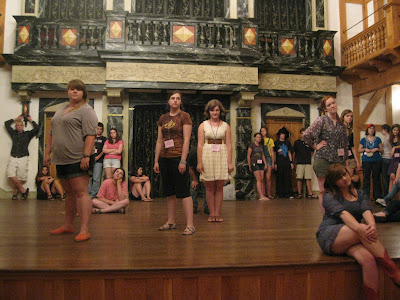
Here are some of the campers waking up the space in the Blackfriars Playhouse, the first evening of camp.
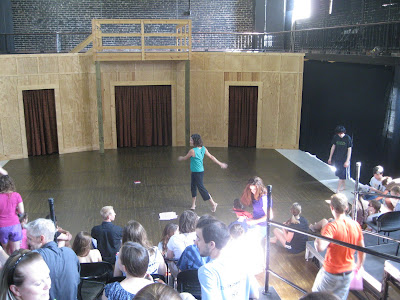
Monday morning, Doreen (one of our camp co-directors) opens the auditions at Stuart Hall's King Theatre, encouraging the campers to make the space their own.
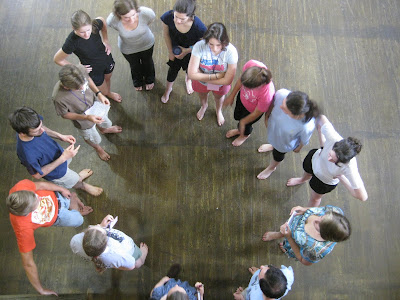
Campers work together in the auditions, planning their wordless storytelling.
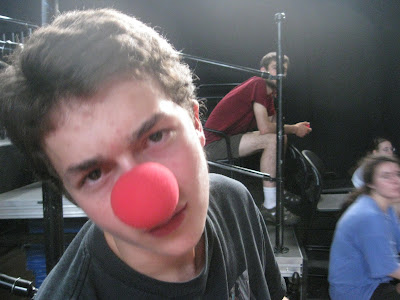
One of the most popular workshops is Clown Class…
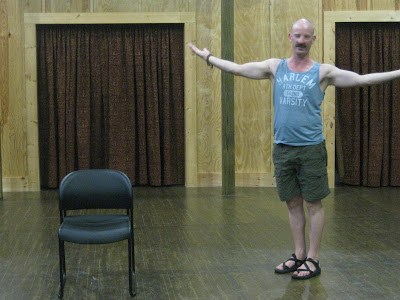
…taught by ASC actor, Daniel Kennedy.
 

Let the clowning begin!
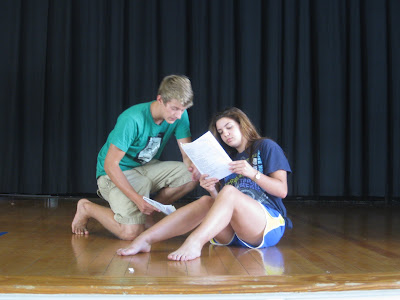
Rehearsals are now in full swing. Lysander and Hermia get lost in the woods of A Midsummer Night’s Dream.
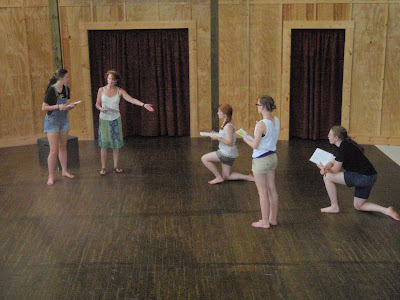
Riley Steiner directs her cast in Dido, Queen of Carthage.
 

“I, one snout by name, present a wall.” In the play within A Midsummer Night’s Dream.

When not working on a scene with the director, campers spend rehearsal working on their lines.
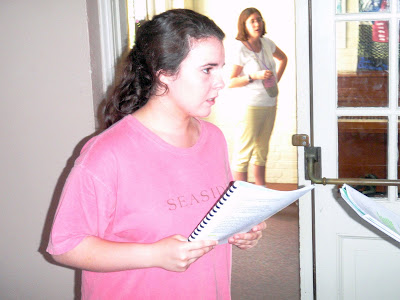
Or running bits of scenes.
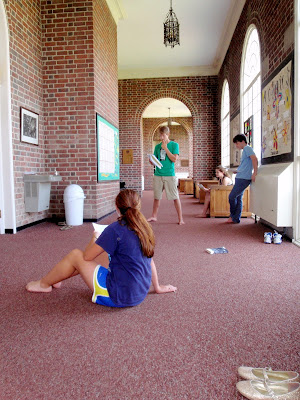
Sometimes with a counselor coaching their work.

Every weekend, the campers go see two shows at Blackfriars, and often dress up for the occasion.
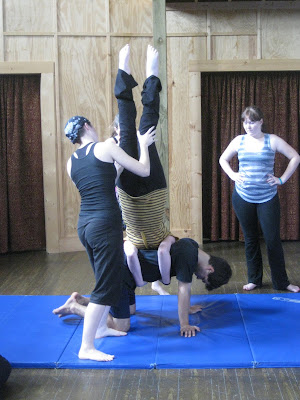
This weekend, Doreen led an acro-balance workshop with help from Tom.
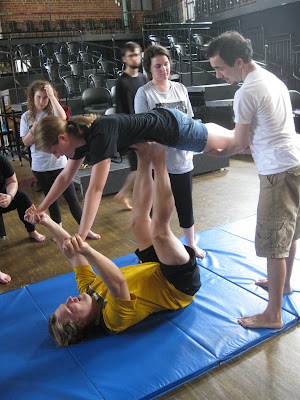
It takes great teamwork.
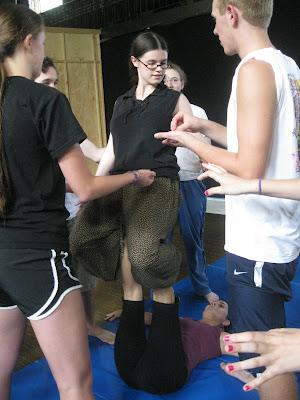
And a lot of trust.
More traditional blog posts coming soon!


Here are some of the campers waking up the space in the Blackfriars Playhouse, the first evening of camp.


Monday morning, Doreen (one of our camp co-directors) opens the auditions at Stuart Hall's King Theatre, encouraging the campers to make the space their own.


Campers work together in the auditions, planning their wordless storytelling.


One of the most popular workshops is Clown Class…

…taught by ASC actor, Daniel Kennedy.
 
Let the clowning begin!

Rehearsals are now in full swing. Lysander and Hermia get lost in the woods of A Midsummer Night’s Dream.

Riley Steiner directs her cast in Dido, Queen of Carthage.
 
“I, one snout by name, present a wall.” In the play within A Midsummer Night’s Dream.

When not working on a scene with the director, campers spend rehearsal working on their lines.

Or running bits of scenes.

Sometimes with a counselor coaching their work.

Every weekend, the campers go see two shows at Blackfriars, and often dress up for the occasion.

This weekend, Doreen led an acro-balance workshop with help from Tom.

It takes great teamwork.

And a lot of trust.
More traditional blog posts coming soon!
Subscribe to:
Posts (Atom)