Header Picture

06 July 2012

Blackfriars Playhouse After Dark


Catherine Gilbert
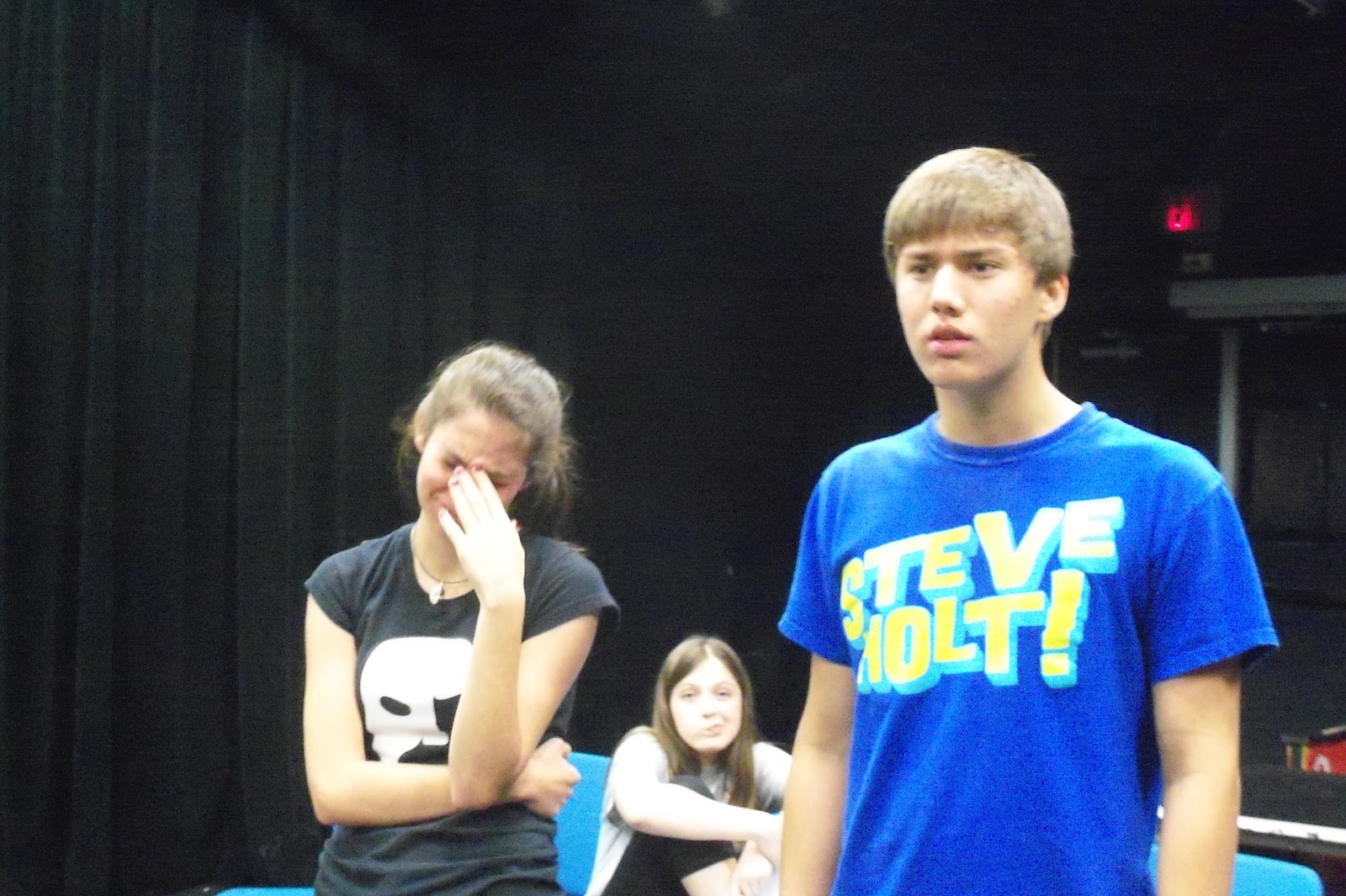
            In preparation for our performances on Sunday, each of the three casts gets the opportunity to have two late night rehearsals on the Blackfriars stage. Since the Blackfriars Playhouse is typically very busy during the day, we take advantage of nighttime to be able to fit in these extra rehearsals. Of the two “late nights“ that each cast gets, one is cast only and the second is a dress rehearsal that the entire camp attends.  So far, each cast has had their private rehearsal in the Playhouse, and Gallathea and Twelfth Night have had their camp dress rehearsals. The cast of Romeo and Juliet gets the chance to show their stuff to the other campers tonight.
Audrey Wood
            These late night rehearsals are extremely useful to the campers. First of all, they allow the campers the chance to acquaint themselves with the space before they actually perform in it. For this reason, when I attended the private rehearsal of Romeo and Juliet, there were moments when we had to pause to adjust some of the blocking, to reconfigure entrances, and to find center for some of the choreography. All of this is perfectly normal. Until now, the campers have only seen the Playhouse stage, and acting upon it will be an entirely new sensation. While the campers can approximate some aspects of the Blackfriars Playhouse, such as the gallant stools, the discovery space, and Juliet’s balcony, it takes time to actually accommodate to a performance space. Thus, in order to ensure a safe performance for performers and audience members alike, the cast of Romeo and Juliet went over each and every one of the many fight scenes in the show. They repeated the fight scenes multiple times and in slow motion, working in entrances and exits and dragging dead bodies. It was interesting to note the change in how the campers projected their voices as they said their lines. The acoustics in the Blackfriars Playhouse vastly surpass those in some of the rehearsal spaces, so it was easy to understand the performers with minimal effort on their behalf. It also made it easy to hear the melancholically appropriate music that the performers sang all the way in the back of the house.

Matt Gieseke Mingles with the Audience
Lily Carr and Leila Silberstein
                 I was unable to attend the private rehearsals of Twelfth Night and Gallathea but I did go to the dress rehearsal viewings that have taken place these past two evenings. As we readied ourselves for the performances, the campers in the other two casts filled the gallant stools and spread themselves throughout the house to attain different vantage points. The directors of these shows have consistently taken advantage of what Blackfriars Playhouse has to offer in putting together the blocking. While it is fairly standard to use the balcony for the musicians to play, the campers have also used it during the actual performances. In this way, we see Olivia lamenting the loss of her family members, as well as Neptune brooding over the defiance of his edict. Furthermore, the performers have clearly been directed in such a way that facilitates communication with the audience. The big saying at the Blackfriars Playhouse is “we do it with the lights on,” which comically references the performance conditions. The audience can see the actors and vice versa. The campers play off of this staging condition by delivering lines directly to audience members. Those sitting on the gallant stools experience an extra level of audience participation. One might be expected to hold one of Cupid’s love knots, to yield their chair to a drunkard, or even to pet a wayward “sheep.”  
Mitchell Peiffer and Gabriel Komisar
            It can be easy for someone who is in one cast to get tied up in what the needs of their show are without really knowing what else is going on in the camp. By having these dress rehearsals for camp members only, the campers can view and comment on the work of their peers. The private viewings also give the performers an audience before actually opening the show to the public, allowing the campers to make their own discoveries about the text or their characters. Some lines that an actor may not have considered that funny might have the house roaring with laughter. Other times, an actor may make simple realizations about his or her character simply by performing onstage. Marina Finelli discovered this about one of her characters, claiming that she had license to be a lot goofier than she initially thought.

Rehearsal for Romeo and Juliet
The late night rehearsals are wonderful to watch. Though it has been great to see what our campers have been working on, most of the fun comes from seeing how their peers react to it. During the Gallathea dress rehearsal, camper Antonia Grisanti laughed so hard she was in tears. Likewise, during a musical scene in Twelfth Night, the campers all clapped along to the music and grooved with their peers. The chief appeal of these private dress rehearsals has been the support that the campers give each other. The cheers and laughter, the “ohs” and “awws,” as well as the congratulatory notes left on each others whiteboards are all indicative of the love that the campers have for each other. Campers, it has been an absolute pleasure shadowing you around and watching you grow. Break a leg during Sunday’s performances, and the best of luck in all of your future endeavors. 

-Madeleine M. Oulevey

Coming Soon to a Playhouse Near You: ASC Theatre Camp Pre-show!

A unique trademark of the American Shakespeare Center that contributes to their commitment to authenticity is their retention of the early modern association of music with playgoing . At the ASC, actors perform music in the half-hour before the show begins, to welcome audiences and to entertain them as they settle in to the Blackfriars Playhouse. The ASC Theatre Camp has adopted and adapted this tradition and will be performing a pre-show for the ASC’s The Lion In Winter on Friday, July 6th and The Merchant of Venice on Saturday, July 7th. They’ll also be performing the pre-show before their own shows on Sunday, July 8th. Symmonie Preston, the ASC's new Director of College Prep Programming, directs this year's pre-show.

ASC Theatre Camp pre-shows have varied in the past, sometimes taking on a specific theme or a single concept. This year, Symmonie’s vision for the pre-show is that it serves as a teaser for the three shows: Twelfth Night, Gallathea, and Romeo and Juliet. Most audiences will not be familiar with John Lyly’s Gallathea, and the pre-show will give the camp a chance to present some of Gallathea’s main plot points as well as the more familiar themes of Twelfth Night and Romeo and Juliet, hoping to entice the audience with hilarity and preposterousness of the play.

Gallathea’s source of conflict for its characters is the monster Agar, who comes once a year to devour the fairest virgin sacrifice, threatening to destroy the land if the citizens fail to provide the maiden. Though he never actually appears in the play, the pre-show realizes Agar using eleven campers and Symmonie’s movement choreography. In progression, the campers fly on stage from various entrances, forming the monster out of many devilish birds. The whirlwind of capes and masks that swarms around the virgin sacrifice has a chilling effect. Another group of campers has created a soundscape for this scene that involves a haunting melody with saxophone and the triangle. Together, the movement and music bring the creepy Agar to life.

The monster scene is one of many in the pre-show, which includes scenes from all three plays. Excerpts from Twelfth Night outline Viola’s predicament and introduce most of the play’s characters. Likewise, the audience gets to witness Sampson’s and Abram ’s fight and a peek into Romeo and Juliet’s cursed lovers’ lives. All ASC Theatre Camp shows run for 60 minutes only, necessitating significant cuts to each script. Luckily, the pre-show gives us the chance to restore some of these cut scenes. Peter’s big scene in Romeo and Juliet had to be cut from the play for Sunday’s performance, but is a part of the pre-show. Campers with more minor roles in their plays are featured prominently in the pre-show so that everyone has an opportunity to lead the stage while at ASC Theatre Camp. For example, Mercutio does not deliver his famous Queen Mab speech for the pre-show; instead, several different campers share the speech, giving them a stab at this famous speech. These campers used diction guidance from the Ralph Cohen workshop they attended to tell a collaborative version of Queen Mab’s tale.

In fact, the pre-show not only gives the audience a preview of the three plays, but also a look inside many different workshops and master classes that the campers attended, as certain elements from these events are part of the pre-show tapestry. At Chris Johnston’s music workshop, the campers helped to write a song called, “Lady, Lay” that involves singing, a troupe of guitarists, and complicated hand-claps. “Lady, Lay” features in the pre-show, along with several other songs that the campers arranged.

The ASC Theatre camp pre-show may precede the main performances, but it is an entire show of its own, making an outstanding start to an afternoon of theatrical wonder on Sunday. Join us at 7:00 on Friday and Saturday night and 11:30 on Sunday morning to see ASC Theatre Camp’s pre-show!
--Emma Lo

Independence Day in Staunton


            Happy Independence Day week from the ASC Theatre Camp! After a full day of stage combat and music workshops, and pre-show and play rehearsals, we finally got the chance to celebrate American independence. We did so first by going to the flagpole located at the highest point of Mary Baldwin College. There, Mary Baldwin’s president and his wife greeted and welcomed us into their home for a special treat. Waiting for celebrants of the Fourth was a lovely ice cream sundae bar complete with three different flavors of ice cream, and every topping one could hope for. 
             By the time we had all received our ice cream (though some sneaked back for seconds) the sky was starting to darken, but it was lit up with a beautiful orange full moon. As we waited for the fireworks to begin, many decided to use the ice cream social to socialize with non-camp members. Though the blanket-spreading crowd consisted mostly of Staunton locals, some of our campers got to know some of the Heifitz  campers who are also staying in the area. While Gabriel Komisar discussed the cello with some, Blaire Sharman and Marianna Moynihan decided to display their art instead. In this way, many of the locals viewed our campers conduct a brief hand-to-hand stage combat demonstration. That’s not the only thing that ASC Theatre Camp members brought to the picnic. Daniel Cassler decided to fight against the odds and fly a kite on what was a fairly breezeless evening. With a great deal of effort, his kite flew for a little while, entertaining those present. Though the campers had spread out on the hill a bit, the promise of sparklers quickly reunited them. Anticipating the forthcoming fireworks, our campers helped to light up the night sky. Although many campers celebrated the Fourth differently during the ice cream social, it was the variety and creativity with which they did that made it so much fun to watch. It spoke to the different strengths, interests, and attitudes of our campers. ASC Theatre Camp brings together students from all over the country, with different backgrounds and day-to-day lives, together to celebrate their love and interest of Shakespeare. A quirky bunch, we celebrated in true, wide-ranging, zany fashion.
While the 4th of July is a day of celebration nationwide, it also happens to coincide with the ASC Theatre Camp’s last week. During this last week, each of the three casts gets to attend a late night dress rehearsal of the other shows. So, after ice cream, fireworks, and less conventional activities, the campers trekked downhill and were privy to an exclusive performance of Gallathea at Blackfriars Playhouse. The Gallathea cast delighted us with song, dance, and hilarity for an hour before we headed back uphill to Mary Baldwin, ending our Independence Day at 12am sharp. 

-Madeleine M. Oulevey

05 July 2012

Adventures with the weather

Many of you reading this blog already know (perhaps first hand) about the high heat and severe storms which put about a million people out of power this past weekend. For those of you who don’t know, I will share our adventure and experiences as we put the “camp” into “theater camp.”

Friday night we all went to attend the ASC’s production of The Merchant of Venice, as was our plan. During the performance, a wild thunderstorm hit, and the power blacked out about half a dozen times. The Playhouse staff were exceptionally calm and professional, and the actors began again after each darkness without missing a beat or dropping the emotional energy of their performance. The whole experience was a phenomenal show of endurance and stamina. At the close of the performance, the Playhouse staff encouraged all of the patrons to stay in the theatre until the storm passed. Though the power had returned to the Blackfriars Playhouse, the power did not come back to the PEG dorm.

We did not gain power again until Tuesday morning, but there are many good things about our situation. The dorm is equipped with an emergency generator which keeps on the hall lights, and a few of the power outlets give a limited amount of electricity, so the campers were able to charge their phones, etc. The cafeteria had very little power, but they have served us every meal as planned. The biggest consideration on our minds was how to keep the kids cool. Like most of the country, Virginia has been enduring high temperatures in the mid-to-upper 90s for several days. To combat this, we switched pieces of the schedule so that the campers can spend as much time inside air conditioned spaces in the heat of the day as possible. Many of the shops, theatres, and restaurants downtown had both power and AC, and so in the free time of the days there were many trips to get smoothies, to see movies, or to see extra shows at the ASC for free. We also shifted all of our rehearsal spaces so that we can keep these kids well and cool.

All in all, was a tough at time, but it was also an adventure. Despite everything, the campers were patient and kind, and they worked to take care of each other and to follow to our many proclamations encouraging them all to drink copious amounts of water. Now that the power has been on since Tuesday morning, life has gone back to normal. And although we’re glad to have the power back, but I’m glad to say we did okay without it.

Gallathea Rehearsals


Catherine Gilbert as Diana and Stone Stowers as Neptune
      We’ve reached week three here at the ASC Theatre Camp.  Campers, counselors, directors, and dramaturgs alike are rearing to go for our big performances on Sunday. By now everyone is off book, costumes are materializing, and actors are polishing up their delivery and blocking with the help of their directors and dramaturgs. Of the three plays that we are performing for session one, John Lyly’s Gallathea stands apart for two reasons: First, it is the only one of the three written by someone other than William Shakespeare. Second, it is entirely in prose. These differences should in no way discourage would-be viewers. As Lilly Carr, one of our campers, said: “Gallathea is ridiculous and funny; complete with cross-dressing that is Twelfth Night on steroids.”  Lyly’s Gallathea includes witty servants, supernatural intervention, and problematic love not unlike many Shakespearean comedic plots. Though the version that will appear on the Blackfriars stage has been cut down to meet the one-hour time limit, Lyly’s text and the performers are not short on humorous charm.   

Doing Text Work for a Scene
Chelsea Phillips, the director of Gallathea, has created an open, organized, and positive environment for the campers. Leila Silberstein spoke to this effect when she said: “I love the freedom that Chelsea gives us. She is always very energetic and positive.” This sentiment is one that many other performers in Chelsea’s cast repeated. At the start of each rehearsal, Chelsea typically informs the campers of what they will be working on and what they can expect during the day. After brief warm-ups hailed as “spontaneous and fun” by Caroline Link, the campers split up into their different subplots to work on their scenes. These divisions do not mean that the campers in one subplot are unaware of the progress and work that their peers in other groups have made. As Calliope George explained to me: “Rehearsals are made up of split-up and group work. We get a lot done while also interacting on a personal level with other members of our cast.” In short, Chelsea Phillips has given her actors the freedom to work and to develop their characters while also providing a structured and positive work environment.

Josie Kritter and Maren Ericsson
Each cast only has three weeks to work on their shows, so there isn’t much time to waste. Even so, Gallathea rehearsals are full of laughter and physical comedy. The characters that Lyly has created are a varied bunch. While some of our campers only play one role, many get to experience several roles through doubling (or even tripling). Lily Carr, for example, plays Robin and the alchemist. In doing so, she faces the challenge presented by clowning: “Playing a clown is a new experience for me. Everything is a lot bigger and expressive.” As the campers soon realized, each new role involves its own set of discoveries and challenges to work with. Since the plot of Gallathea calls for more than just clowns, there are many types of characters. For example, much of the plot revolves around the pesky problems posed by the involvement of deities in both life and love. As such, some of our campers have been faced with playing the parts of Roman gods. When I asked about her experience playing Diana, goddess of the hunt and the moon, Catherine Gilbert said, “Diana has been a challenge. She is very headstrong and stubborn. Not at all like the more lovey characters I’ve had to play in the past.” Gallathea also features a set of lovers, played by Campbell Long and Calliope George. Gallathea and Phillida are similar characters. For this reason, Cam and Calliope emphasized that their “challenge lies in making our characters their own people. Our characters have essentially the same backstory and motives. We need to make it clear to the audience that they are vastly different… oh, and in love.”
Stone Stowers as Neptune and Marina Finelli as Venus

It has been an absolute delight to observe the rehearsals for Gallathea. Chelsea’s positive energy combined with the natural humor and creativity of the campers has yielded a production that is bound to delight. Already a wonderful show, Gallathea has doubtlessly been made better by what assistant director and counselor Francis Whitesell called “the deep abiding love that the cast has for each other.”  A great amount of effort, energy and hard work has gone into making Gallathea, and I hope that anyone who can will take advantage of the opportunity and come out to watch it Sunday, July 8th at 2:45 at the Blackfriars Playhouse!  

-Madeleine M. Oulevey

Selling the Danger: Combat Masterclass with Benjamin Curns

On Monday, the campers were advised to "trust no one and give people every reason to trust you" at a combat workshop led by ASC actor Benjamin Curns. This workshop focused specifically on knife fighting, which Ben described as “the nastiest, because you have to get so close to your opponent to do some damage.” Most people consider the only dangerous part of the knife to be the point, but Ben revealed that almost all of the different parts of the knife can be used to harm. The advantage of using a knife is that one can easily switch hands with a knife as opposed to bigger and more cumbersome weapons.

Ben began the workshop by giving a general overview of how to perform a knife fight in a safe and convincing manner. Combat can be dangerous if the fight partners are not effectively communicating about their actions. To ensure safety, you must use constant eye contact and big cues to let both partner and audience know where you’re coming from and where you’re going.

As precautionary advice before the fighting commenced, Ben reminded the campers that they would not actually be fighting. “We’re learning how to miss and keep your partner safe. It is athletic, but it is not a sport. Everything is predetermined. No one is going to best anyone.” He warned that combat is completely dissimilar to martial arts or boxing, where opponents are trying to harm each other and win the fight. Instead, the goal of stage combat is to have the audience walk away and say that the fight looked real and intense. The job of the actor is to sell that there is danger at every moment, while all the while preventing any actual danger from happening.

After Ben’s introduction, the campers formed a circle: “The Arena of Death.” Counselors Emily and Dan demonstrated how a fight would begin, slowly pacing around the circle maintaining eye contact. Ben pointed out that despite the discrepancy of Emily’s and Dan’s body types, difference in strength wouldn’t really affect the fight because of the size of the weapon. The campers were asked to find the story in the counselors’ physicality. Campers noted how Emily’s bent knees and slow approach put her on the offensive, while Dan’s engaged left hand signified his preparedness for defense. When both switched from the ice pick grip to the standard knife hold, the campers knew that the fight would soon begin. Even without dialogue, the campers could gage the fighters’ relationship and identify their intent.

The campers then partnered up to try their hands at knife fighting. All laughed as Ben unknowingly paired the campers playing Juliet and Romeo together. Today the star-crossed lovers were going to have to battle to their deaths! First, Ben asked the partners to approach each other slowly, and once they were close enough, to leap into fight stance.

After the campers were comfortable with these initial steps, Ben entrusted them with wooden knives with dulled points. If a camper dropped a knife, the offender had to drop and do ten push-ups as punishment. The campers performed all moves at a decreased tempo, as Ben required that the campers “go crazy slow as if this entire room is filled with molasses”. The fight the campers learned began with a hand-to-hand combat sequence, with their knives temporarily hidden in belts or pants where the fighters could easily access them with their right hands. After the partners threw and deflected several different punches, the fight escalated to sword-play. Once the knives were drawn, the opponents went through a series of cuts and stabs. Some of these moves, if performed in actuality, would be pretty brutal, including a stab to the back that goes in between two ribs, directly to the heart. At the end of the fight, one actor would be left with a big debilitating armpit wound and no weapon, while the other stood doubly armed and triumphant.

Once the campers perfected those sequences, Ben distributed a dialogue of two or three lines from various Shakespeare plays to each pairing. The edition of lines from Macbeth, King Lear, and The Comedy of Errors helped the campers to place their motivation for fighting. Reciting lines in the midst of the fight brought a new passion to the choreography. Several pairs performed their short scenes for the whole group, which were thoroughly convincing after two hours of polishing. Ben praised the performers for remaining slow and safe in the heat of the moment, noting that the presence of an audience increases the temptation to speed up. The young fighters reluctantly returned their wooden knives but left the Masonic building with new skills under their belts.
--Emma Lo

03 July 2012

Romeo and Juliet Rehearsal

As an observer of Romeo and Juliet rehearsal, I entered through the walls of Verona into a world of wooden daggers, tennis shoes, and first kisses. Putting on Shakespeare’s most famous play is no easy feat, as the tale of Romeo and his “three-hours wife” has enjoyed (or endured) countless retellings in countless varieties. But under the direction of Sara Holdren, the ASC Theatre Camp is tackling Romeo and Juliet with a vivaciousness you will find nowhere else. One of the most significant rehearsals I’ve sat in on was the cast’s first run-through. In the words of the director, “This is the first time you guys get to put the whole thing together. Keep your energy up. Keep your focus up”. Sara encouraged the actors on this intimidating day, when all of the lines, entrances, and blocking have to be at the front of each actor’s mind in order to make the run-through efficacious.

Run-throughs always begin with a fight call, where the actors lace up their sneakers and briefly practice all the show’s fight scenes at a slower tempo than they will use in the actual performance. This way, the actors won’t be going into these scenes cold during the run-through, which could result in confusion and possible injury. Stage combat in its essence is ironic because it’s the exact opposite of fighting. The fight partners work hard together, sharing weight and doing as much as they can to support each other in this mimic of a fight. Fight call is both an opportunity to practice the physical progression of the fight and also the accompanying vocals and expressions. One camper watching the fight call scenes praised Tybalt’s “troll face” that intimidated the entire room. Sara encouraged the actors to experiment with their pain noises and to imagine a realistic reaction to a sudden cut to the hamstring.

After fight call, the cast formed a circle to warm-up physically and vocally. It’s important that the campers’ bodies are fit to perform an active hour’s worth of brawls, dancing, and dying. Likewise, the shouting matches and the language in this play call for an extensive warm-up of the voice as well. The cast practiced lip-trills to loosen the lips, sirens to use the full vocal range, and overdone diction to ease the delivery of lines. The last warm-up is always an energy warm-up, as it’s crucial to build up enough energy to last through an hour of performing. Starting low to the ground and in quiet voices, the cast began to chant, “Ooh I feel so good, like I knew I would!” As they repeated this line again and again, the campers became increasingly loud and wacky until they were shouting and jumping into the air ecstatically. With a huge burst of energetic expression, the cast was now ready to tackle the play.

One of Romeo and Juliet’s biggest challenges is the “transition from a world that’s full of humor to that great tragedy” that Sara identifies as one of this cast’s biggest successes. This was profoundly evident from watching the run-through and the reactions of the cast further underscored that importance, when they served as audience members for the scenes they were not in. Almost Mercutio’s bitter death speech brought almost half the cast to tears. During the big fight between Mercutio and Tybalt, the cast watching divided and cheered them on, chanting “Mercutio! Tybalt! No, Mercutio! No, Tybalt!” In the middle of the Juliet and Romeo’s first encounter, Sara suddenly called out, “I’m so sorry, but this is where the first kiss is. You guys better get used to doing this!” The entire room blushed as the pair “let lips do like hands do.” From tears to heated shouts, gasps of surprise to reddened cheeks, this cast has the ability to affect and move each other through an entire range of emotions that Romeo and Juliet calls for, as a romantic tragedy.

While watching the rehearsal process, it’s easy to imagine you are with these characters inside the church’s tomb, until a hilarious mishap pulls you straight back to 2012. As Juliet awoke from her poisonous sleep, she accidently elbowed her dead husband, prompting an “Ow!” from the miraculously and momentarily arisen Romeo. It’s fun, light-hearted moments like this that alleviate the serious and hard-working tone that runs through rehearsal.

Rehearsal ends with notes, a reflective time when the director and assistant directors share comments, suggestions, and changes they’ve noted throughout the run-through. The campers write down their notes in their script margins and will try to incorporate them in the next run-through. While Sara found places in every scene that needed adjusting, she stressed that they had had an outstanding first run-through, and are well on their way to a polished product.

When asked to describe the cast, Sara was eager to praise this talented group, saying that they are “really brave and really willing to throw themselves as deep into the play as it calls for. They’re a great group, they’re funny, hard-working, very brave, open honest with each other, good listeners. They’re a group with a really good energy, with a nice feeling of ensemble”. Sara’s favorite part of rehearsals so far has been “the energy and the commitment level of the kids because I’ve seen versions of this play done by adults where the energy levels haven’t gone as far as the play asks for emotionally”. And it shows, as Sara and the cast do a wonderful job of using the youth of these actors to make Romeo and Juliet a thoroughly convincing tale of young love.

The performance of ASC Theatre Camp’s Romeo and Juliet, along with Twelfth Night and Gallathea, will be on 11:30 Sunday, July 8th at the Blackfriars Playhouse. Admission is free.

--Emma Lo

28 June 2012

Specificity and Cookie Voices: Vocal Work with Allison Glenzer

Alli’s Voice Workshop

On Monday, half of the campers attended a voice workshop taught by an American Shakespeare Center actor Allison Glenzer. Although some campers met Alli for the first time at the workshop, they have all seen her perform this season in The Merchant of Venice and The Lion in Winter. Her bio can be found here, on the ASC website. The other half of the camp will attend the same workshop next week.

In a mere two hours, Alli expanded the generic definition of voice enormously by showing what elements of the body and mind we use to produce a voice, and by helping the campers to explore the full scope and range of their voices. Alli began the workshop by having the campers check in with descriptive similes of their current mental and physical conditions. They were invited to compare themselves to the weather, breakfast foods, or cars. One camper said she felt “like a glass of still water” and another like “a lightly toasted piece of bread with butter and honey”. The purpose of this exercise was to encourage the campers to avoid using vague and meaningless words like “good” and “fine,” because the last thing an actor wants to convey is vagueness.

The campers moved on to a full exploration of their bodies in relation to their voices. Alli used the Linklater Progression, affectionately known as “Zoo Woah Shah” to help the campers link body parts to potential vocal tones. Starting low in the knees and then moving upwards through hips, chest, chin, nose, eyes, and forehead, Alli guided the campers in producing distinctive vocal colors. Having an extensive range of different voices gives an actor many avenues to express his or her gender, temperament, and context more clearly and specifically.

Alli not only provided the campers with the tools to improve their vocal acting, she also boosted their confidence in their abilities to use these tools. When asked, “Have you ever had trouble hearing a baby cry?” the campers laughed and shook their heads. “We are built to be heard,” Alli replied, proving that although society teaches us to quiet down and be polite, a large voice is something we inherently possess and thus something we can rediscover. The campers were compelled to find their “I WANT A COOKIE” voice, or the voice a toddler would use to demand something. After working with the campers on volume, Alli moved on to diction and precision, reviewing the differences between voiced and unvoiced consonants, like p vs. b, f vs. v, and s vs. z. She then challenged their dexterity with a handful of tongue-twisters. The room was soon filled with the quick-paced chanting of “I slit a sheet, I sheet I slit, upon a slitted sheet I sit”!

To culminate the workshop, the campers got a chance to apply what they had learned from Alli to the plays they’re currently working on. Each selected one memorized line of his/her character’s text, and then performed it as audibly and precisely as possible, making sure to aspirate the consonants. The campers proved they had learned well, shown by Alli’s jumps of excitement at one camper’s skillful execution of a tough line riddled with ‘f’s!

As a closing exercise, Alli asked the campers to reinforce something that they wanted to remember from the day’s session. One camper reinforced that thinking specifically will help you speak specifically. Another reinforced the value of doing vocal warm-ups every day. And the general consensus was that Alli’s thorough and enthusiastic instruction left us all wiser, louder, and really wanting cookies!

--Emma L.

27 June 2012

History of the Book


            Much of what we do here at the ASC Theatre Camp has the campers up on their feet working with the text, but a certain portion of our efforts go to ensuring that the campers learn about the significance and history of the texts that they are working with. During the course of our three-week camp, we bring in lecturers that teach the campers about their different specialty areas. Sarah Enloe, our Director of Education at the ASC, introduced guest lecturer William Proctor Williams as being something of a “Scholar Adventurer."  Part of his career has involved “finding buried texts” and ensuring that they are properly preserved for future generations. One of his biggest finds was unearthing twenty-three dramatic manuscripts from the seventeenth century. While this is one of his largest successes, William Proctor Williams has been salvaging Early Modern texts from being discarded since grad school.

            If we had had more time than the two and a half hours that were set aside for this lecture, I am sure that we would have been treated to a full history of the written word. Williams was extremely thorough during his lecture, and he answered the campers' questions down to the most specific detail. Despite the time constraint, Williams’s lecture covered lots of ground. Williams began his lecture by explaining the evolution of the book, beginning with 3000 BCE and the use of the papyrus scroll. As he described the evolving forms of binding, he passed around a text with a cover made from vellum (calf-skin) on it. With the development of the printing press, he explained, Gutenberg combined the three major technologies of the day. One of these was the type of binding that was in use. Were it not for this shift, Williams said, we would all be vegetarians since the increase of demand for text would have caused veal to disappear altogether!

Williams’s lecture then transitioned from technological developments in printing to the working conditions that Jaggard, the manufacturer of the First Folio of Shakespeare’s plays, would have worked in. The way we think Jaggard’s shop was run worked remained the standard from 1450-1750. His shop is thought to have contained three compositors, one compositor’s apprentice, two pressmen, two or three additional apprentices, a master printer, and a full or part time scribe. The average printer’s workday went from 5am-8pm, during which time they churned out somewhere between 900-1200 copies of a text per day. Ha, and the campers think we work them hard! Learning about the expected productivity of Jaggard’s shop seemed to make everyone a little more appreciative of our own work hours.

Williams ended the lecture explaining that part of working with Shakespeare’s text is learning about the historical conditions in which it was printed. This includes how the printed format that we now work with may have been adapted from the stage to the page.  Williams’s lecture was in-depth and informative. He was able to provide the campers with a vivid image of the history of the book in addition to answering questions that the campers had for him. All in all, it was an immersing and engaging lecture chalked full of information that will be useful to the campers as they work through their text for our upcoming productions!

-Madeleine M. Oulevey

26 June 2012

Sonnets are about Love

In ASC Theatre Camp, the night before the last day, we have “Sonnet Night” where every camper and staff member reads a sonnet he or she has written to another member of the camp. It’s a night full of love, usually full of tears and happiness at all we’ve gone through together. Your sonnet partner is secret until the event itself, and people are encouraged to dress up as the person they are celebrating. It’s a pretty wonderful tradition, but it means that people need to be thinking about it early on in the camp. So here are some hints on sonnet writing for any of you interested in joining in on the love.

Some Tips for Sonnet Writing

What is a Sonnet?
A Shakespearean sonnet is a fourteen line poem, in iambic pentameter with three quatrains and a couplet.

Wait, iambic pentameter?
We’ve talked about this a bit in camp already, but just to refresh, iambic pentameter means that there are 10 (or occasionally 11) syllables in every line and that usually syllables 2, 4, 6, 8, and 10 are emphasized. For example, “To hear with eyes belongs to love’s fine wit.” In this sentence, the emphasized words (or syllables) are also nice meaningful words, and the connecting words like “to” and “with” have less emphasis.

Three Quatrains and a what?
Quatrains and couplets are terms used in poetry indicating a rhyming pattern. A quatrain is a set of four lines with alternating rhyme (ABAB) and a couplet is just a pair of two lines which rhyme back to back. So the scheme for a (Shakespearean) sonnet is ABAB CDCD EFEF GG or three quatrains and a couplet. Here’s one of Shakespeare’s sonnets if you’d like to follow along:

As an unperfect actor on the stage,
Who with his fear is put beside his part,
Or some fierce thing replete with too much rage,
Whose strength's abundance weakens his own heart;
So I for fear of trust, forget to say,
The perfect ceremony of love's rite,
And in mine own love's strength seem to decay,
O'ercharged with burthen of mine own love's might:
O let my looks be then the eloquence,
And dumb presagers of my speaking breast,
Who plead for love, and look for recompense,
More than that tongue that more hath more expressed.
O learn to read what silent love hath writ,
To hear with eyes belongs to love's fine wit.

What if I can’t find any words that rhyme?
There are lots of rhyming dictionaries online, you can look for some rhymes there.

Anything else I should know?
If you’re stuck for how to organize your sonnet, Shakespeare often uses the first eight lines to ask a question or state one idea. The final six lines can then answer the question or express something different and the final couplet makes sense all by itself. You could even write your final couplet first.

Sonnets in this camp are about the community and learning and love we’ve all had together, so remember that as you write to your secret sonnet-er: sonnets are about love.